Monday, January 27, 2014

Why I'd Love to Live in a Dystopia


  Lemon is an eventual librarian who reads dystopian YA novels by the barrelful...
...so reads my bio on the front page of this site. But I don’t talk much about YA or dystopian fiction, even though by page count it’s probably the majority of what I read. Often it’s because I read those books more for enjoyment than analysis, which I’ve come to realize is a disservice both to those books and to everything I believe about young adult literature. Consider this me catching up.

  Though the worlds of each of the currently incredibly popular dystopian books are different, they (nearly) all have one thing in common: structure. In The Giver, everyone is assigned a career, spouse, children, etc, and the beginning of adolescence is celebrated with a pill to suppress sexual urges. In Divergent, people categorize themselves, and each faction organizes itself based on the strengths of its members, according to the traits they define themselves with. In Delirium, love is considered an illness, and every citizen is inoculated against it once they're of age. Shades of Gray depicts a world in which people are valued according to the colors they can see and the degree to which they can see them, creating a very ordered class system with few variables.

The reason dystopian and fantasy novels like these are so often aimed at young adults is that young people in these stories are the only unpredictable thing: old enough to think for themselves and to fall in love, but not old enough that they’ve taken their place in the system and lose control of their choices. Their stories usually start with them buying into the structure, until some event or person becomes the catalyst for their questioning. Sometimes this leads to all-out revolution, a la The Hunger Games, or to a smaller-scale change, like Jonas releasing a single community’s suppressed memories in one overwhelming moment at the end of The Giver.

Here’s why I find this interesting. Young adults often see the world of adulthood as ordered and predictable, and there comes a point for everyone when you realize that it isn’t. I don’t think there will ever be a time when I won’t find that moment interesting. Call it a coming-of-age story, call it a bildungsroman, whatever-- but that moment has been a staple of literature for decades, if not centuries. In a dystopian setting, the world of adults actually is strictly structured, but full of flaws that real-life adults often fall into, though they do it on a more individual basis. The structures deny fundamental aspects of being a person, like falling in love, freedom of choice and remembering their history, whether personal or shared. It’s up to the next generation, as it is in the real world, to learn from the mistakes of those who came before them and be better, to break free and show the rest of the society a better way.

In these novels, they’re usually the only ones who can affect change in a much more literal sense-- they’re the only ones who haven’t been assigned a faction, or who haven’t been given drugs to prevent rebellion, or whatever the totalitarian regime’s soup du jour happens to be. In reality, young adults aren’t the only ones capable of making changes, but they’re often the only ones likely to. Their perspective hasn’t been cemented yet, and the entire world serves as a cautionary tale.

The premises of these novels are rarely based on something that could never happen. Most of them rely on an unspecified apocalyptic event, presumably a nuclear war, to wipe out existing governments, and examine how the world would choose to reshape itself afterwards. The new government does whatever it does in the name of protecting its citizens. All these people have built their society and their lives around avoiding something, avoiding whatever it is they’ve determined is the enemy. The young people (is there any term here that sounds natural? The teenagers? The youths?) are on the outside of that decision looking in, and they don’t think it makes sense. They see both good and bad in the thing their parents or grandparents have decided to exclude from their lives, and they want access-- to memories, to love, and most importantly to freedom of choice. And they’re willing to fight for it in the way the adults around them are not.

This is why I’m so interested in these stories. What are we organizing our lives around avoiding, and why are we doing it? Is there something we want to save the next generation from, and is there a chance we’d be better off letting them save us instead? If our safety was taken away, what would we sacrifice to get it back? These novels, and others like them, give me a chance to ask those questions in a way that’s just distant enough to give a little objectivity, but close enough to make me realize their importance. 

With every new dystopian book I pick up, I start out thinking about the positives of the world they’ve created. Most of them seem comfortable and easy. It’s only by following them through to their conclusions that I find out that thinking is a flaw in myself, that I value security over doing the right thing too often. I need these stories, and people like these characters, to remind me that just because reality isn’t comfortable or easy doesn’t mean those things should be my goal. There are more important things, and I’m thankful I can read these books to figure that out rather than going through a nuclear apocalypse.

-Lemon

Thursday, January 23, 2014

Surrender, Dorothy and the Ownership of Grief

If you guys showed up today hoping we’d eventually shut up about Meg Wolitzer...sorry. Try again next time.


I went to a funeral a couple of months ago.


7,000 people attended, either in person or by watching online, to offer their support to the family of a sixteen-year-old boy killed in a car crash three days before. The service was held so quickly because the day they chose was the sixth anniversary of his father’s death from cancer.


My dad asked me afterward how much being at funerals reminds me of my mom’s, and I said that there will probably always be some connection, but that wasn’t what was tearing me apart about this one. I can relate to my friend, their oldest daughter, when it comes to the loss of her dad. I haven’t lost mine, but there’s common ground there in losing a parent. I even feel like I can empathize with her mom a little, having watched my dad go through losing a spouse. But losing a sibling, or a son, is such a completely different beast. I didn’t know how to offer any support or comfort when I knew that my understanding of their loss went this far, and no farther.


So that’s always the question, isn’t it? How can I help when I can’t understand? Maybe that’s my own flaw, that I don’t feel like I have a place to offer comfort if it’s something I haven’t already earned for myself. I can be there, I can listen, but I can’t connect the way I can when I’ve been where they are. It feels like an invasion to offer anything I’m not confident will be useful, when I know firsthand that most of the things you hear while grieving are useless at best and harmful at worst. I’m sure there’s a more productive middle ground, but usually my course of action is to tell someone I love them, I’m praying for them, and then acknowledge that their grief isn’t mine and leave them alone.


Surrender, Dorothy is about the aftermath of a young woman’s early death. Sara dies in a car accident while on an annual summer vacation with her closest friends, who decide to stay and finish out their time there after her death, joined by Sara's mother. Most the conflict in the book comes from one question: who owns this loss? Her mother is her only remaining family, and she comes in expecting Sara’s friends to submit to her without question-- to know that she has suffered the biggest loss, and that her life is most affected. Her best friends, Adam and Maddy, take issue with this. Adam was with her in the car accident that killed her, and feels that no one respects his loss because he and Sara were never romantically involved. Maddy has been her best friend since college and arguably knew Sara better than anyone. They’re all mourning different versions of their friend, and they all feel entitled to grieve.


It seems strange to say it that way, but can certainly be how it feels when you lose someone close to you, particularly if it’s sudden or especially tragic. Of course anyone can be sad, but depending on how that's expressed to the closest of family and friends, it comes across either as kindness, we’re-all-in-this-together-ness, or as asking you to bear not only your own grief but that person’s too, as if yours was less important. These quotes from the text sum it up as well as anything:


“No one laughed. Finally Maddy said, “I can’t believe you’re making a joke now.”
“I’m sorry,” he said. “I don’t know what I’m supposed to say.”
“Then just say nothing,” she said, and the subtext was that Sara had been her close friend, not his, and that he ought to shut up forever.”


“Now she had the ability to tower over him in the monstrous bloom of her grief, could in fact kill him if she wanted to, and he would let her.”


I suppose on a base level, the question of who has the strongest claim to the loss is one of authority. If you’re in the most pain, other people will serve you, will respect you, will set aside their own feelings for yours. If, as in this story, several people are all fighting for that position, they are all going to feel as if they need that authority to grieve, and not getting it will make them lash out. Of course it doesn’t actually have to be that way, but mourning is not a logical thing, and during such a tenuous time, anything can upset everything.


A couple of years after my mom died, I asked my best friend how my mom’s death had affected her. We were part of each other’s families, and I knew she missed my mom too. But she didn’t have an answer. She had been focused on me and my grief, and hadn’t thought about what it meant to her. Conversely, I recently heard that a distant family friend I haven’t seen in ages hasn’t been to a funeral since my mom’s, because facing everyone she’s lost is too overwhelming. She doesn’t go to memorials anymore. I didn’t know what to make of it. I was surprised by who was and wasn’t suffering, once I had enough distance to notice.


The characters Meg Wolitzer writes in Surrender, Dorothy are not particularly likable. They are privileged, entitled and bored. But good stories don’t require nice people, thank goodness, and these characters create the perfect situation for some very important questions. Yes, grief is chaotic, but we impose structure on it because we need to. Someone has to be in charge, be the person everyone else gets their cues from. Who should it be, and why? What does that role entail, and what other roles must be played? What does it mean to own a loss when you can’t own a person? And finally, can grief ever be truly shared, or does it always end up being carried in different ways by different people?

-Lemon

Monday, January 20, 2014

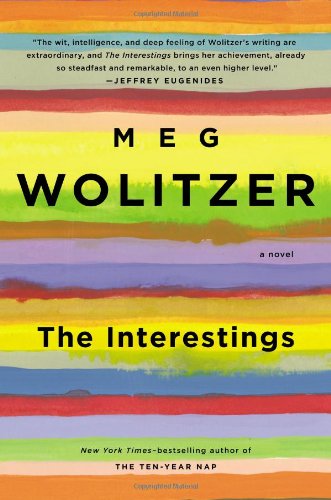
Kansas and Lemon Discuss The Interestings

Meg Wolitzer’s newest novel, The Interestings, follows a group of friends from the time they meet at a summer camp for artistically gifted teenagers until their fifties. They all start out believing they’re special, talented, better than everyone-- which is complicated when they grow up and only some of them live up to those beliefs. The Interestings (the name they give themselves at camp that first summer) consist of Jules, the main protagonist, who comes to the camp on scholarship after her father’s death; Ethan, an awkward and homely but extremely talented young cartoonist; Ash and Goodman, stunningly attractive brother and sister who come from a wealthy Manhattan family; Cathy, a slightly out-of-place member of the group who is seen as more experienced and mature; and Jonah, the son of a famous folk singer, who is more troubled and fragile than any of them realize.
Lemon and Kansas want to talk about this book in a different way than we usually would, because we have a lot of feelings about it. We’re going to take turns asking each other questions about the book, and we’ll try to keep it as straightforward as possible for those who haven’t read the book (which should, eventually, be NONE OF YOU).


Kansas: Lemon, please rate this book from 1-10 in the following four categories: Feels, Sexiness, Comedy, Truth Bombs.
Lemon:
Feels: 8. I think in order to earn a higher feels rating, this would have to be part of a series. And it’s not. But it did make me cry, which is saying something, especially because you did not cry, which I feel is probably a first for us.
Sexiness: 2. There is very little good sex in this book, which is fine, but does not contribute to a high sexiness rating. In addition, the only people I liked are supposed to be very unattractive. So. Not a sexy book.
Comedy: 6. I don’t remember laughing a lot at this book, but several of the characters are witty and there’s also all the comedic elements that come along with being a youth.
Truth Bombs: 9. READ ON FOR DETAILS.


L: Kansas, please explain to me the role you feel adolescence plays in this novel.

K: This is a great question. For the first section of the novel, it is paramount. They’re all teenagers, and like most teenagers, they are very absorbed in their teenage lives and issues. As they grow up, most of The Interestings (4 out of 6, to be exact) remain each other’s closest friends. They keep each other tethered to this phase of their development. They are constantly reminiscing and even pining for the days when they all first met and the most magical summer camp on earth. Seriously. they are obsessed with this place.
One of the minor characters makes a comment to Ash and Ethan at one point, noting how unusual it is to stay so attached when they met at fifteen, but none of them find anything odd about it, even though it is. Their lives go in drastically different directions; they probably should have other friends. The members of the group branch out for casual friends and romantic partners, but they remain each other’s best friends and form some semblance of a family into middle age.  
They remain an exclusive group, and that connection to their teenage years is vital to their continued relationship. Because of this, all of the characters experience stagnancy throughout the novel. They each maintain aspects of adolescence that they should have outgrown. Jules remains completely self-absorbed and in a constant state of want; even when she realizes she’s being childish, she persists. Ash clings to her naivety under the guise of loyalty. Goodman literally runs from adulthood and all its responsibilities. Jonah is in a state of arrested development until he is in his 50s, and Ethan refuses to let go of the idealized crush of his youth, Jules, despite her clear lack of reciprocation and the fact that his wife, who loves him, is more successful, beautiful, wealthy, etc.
There are some wonderful and terrible parts of adolescence. Overall, I think we can agree that it’s the worst, but for this group of people, it was where they formed their identity and met their best friends. I can understand, kind of, why they would be unwilling to let go of it. What Wolitzer may be getting at, as she details the ups and downs of the character’s lives, is that clinging to a stage you are meant to outgrow, is damaging to your future, your relationships and your overall happiness. Most of these characters don’t realize how unhappy they are until it is either too late or 40 years has passed. The characters either have to learn to be best friends apart from their first summer together and in the new context of adulthood, or remain the same selfish teenagers they were when they met.


K: Lemon, why and in what ways did you relate to the characters in the novel?

L: Thank you for asking, Kansas! You know we’re both big fans of stories that take a long time to tell-- not just that are long, exactly, but that take place over a long period of time. Jules is fifteen at the start of this book, and it ends when she’s in her fifties. I found her relatable as a character, as I think any girl who grew up considering herself smart would, but I noticed a significant dropoff in how much I related to her as the story went on.
When we first meet Jules as a young woman, her identity is basically just that she is pretty smart, pretty funny and very awkward, and she’s just lost her dad. She only begins to consider herself “interesting” because of the friends she makes, and it’s true that as a unit they’re a lot more interesting than they would be on their own. I related to all of that.
As she grows up, she tries to achieve a level of success that she never even comes close to actually getting, and she finds out she isn’t really that special. I can relate to that too.
Then, in most of the adult portion of the novel, I suddenly wasn’t relating anymore. I don’t have an established career that I’m kind of disappointed by. I’m not married. I haven’t really given up any dreams yet. I don’t know which of my friends will be successful enough to make me jealous and how I’ll deal with that.
In a lot of ways it felt kind of prophetic, because I’d felt a pretty strong kinship with Jules when she was young. Like, is this what’s going to happen to me? Is this how I should expect to feel later, depending on how things go over the next ten years? It was such a unique experience as a reader, because usually I either relate to a protagonist or I don’t, and going from one end of the spectrum to the other with one character is very unusual.


L: Kansas, would you like to discuss the ending of the novel? (I will type out the final paragraph here, for those of you who have not yet read the book but enjoy things that are good.)

“Jules stood and looked at Ethan’s drawings again. Finally she placed them in the chest in the living room where she kept the few things that corresponded to that time in her life. There were the signed, spiral-bound Spirit-in-the-Woods yearbooks from three summers in a row and the aerial photograph of everyone at camp the second summer. In it, Ethan’s feet were planted on Jules’s head, and Jules’s feet were planted on Goodman’s head, and so on and so on. And didn’t it always go like that-- body parts not quite lining up the way you wanted them to, all of it a little bit off, as if the world itself were an animated sequence of longing and envy and self-hatred and grandiosity and failure and success, a strange and endless cartoon loop that you couldn’t stop watching, because, despite all you knew by now, it was still so interesting.”


K: I’m audibly sighing over here just rereading this perfect last paragraph. I mean, the last sentence itself, come on. You’ve outdone yourself Wolitzer, you beautiful, perfect woman. But seriously, when it comes to endings, I’m pretty judgy. If an ending is wrong, if it doesn’t live up to the rest of the book, it will ruin the entire thing for me. It’s just that they’re so important. Also, endings seem like the most difficult and overwhelming thing a writer can ever attempt to take on.
I dabble in fiction writing (I will never let anyone see it because I hate all of it, but I keep trying) and when you create characters, they’re very easy to lose control of. Sometimes I will only be on my fourth page and suddenly I have no idea who these characters have become. They are wild animals, completely unpredictable, and I know I’m the one writing them, but it’s a way bigger undertaking than you think when you’re only reading fiction. So to think that some writers can not only wrangle them all back together for a coherent ending but also do it perfectly and beautifully in a way that makes Lemon cry... It’s just too much. So, two things: I will hate a book if the ending is bad, and a good ending is incredibly impressive to me. Wolitzer is queen of endings, and this book will be her ending legacy. I’m probably being dramatic, but I can’t get over it.  
The last 10-15 pages of the book are emotional and overwhelming, especially after spending 460 pages with these characters. Some crazy stuff happens at the end, as if Wolitzer is trying to make her job of creating an ending even more difficult (she would). There were a lot of easy, predictable routes she could’ve taken with the last few pages and her last words, but she didn’t. She didn’t try to gloss over anything or tie a nice ribbon on this beautiful dysfunctional group of friends and make it seem like they somehow transformed into better, happier people. The last sentence in particular emphasizes both how flawed these people were while at the same time confirming how deeply they cared for one another. That to me is so completely relatable and perfect. I read the last sentence to my husband out loud because I couldn’t understand how one sentence could summarize all of my feelings about 470 pages of literature, but it did. Of course, he only heard one sentence of the book. No tears were shed: he’s not hailing Queen Wolitzer. But judgemental reader Kansas over here is saying she did it perfectly, and I want you all to read this book so you can understand that.


K: Lemon, please talk about Dennis. First, tell them who Dennis is, then talk about why you hate him and stuff.

L: Well phrased, Kansas. I would love to talk about Dennis and all his flaws.
Jules ends up marrying a man she meets post-college through a mutual friend, and that man’s name is Dennis. He is described as steady, as looking like a bear, as dependable and blah blah blah. I don’t actually hate Dennis, really. I just think he doesn’t fit in, which, to be fair, so do all the other characters in the book.
I spent a long time trying to figure out why I didn’t like Dennis while I was reading the story. Partially, I think it’s because it’s shown in the book that who you marry has an effect on how successful you become. Ethan probably wouldn’t have gotten as far as he did without Ash’s money and social connectedness behind him, and she made up for everything he lacked. I think I was holding out hope that Jules would have the same story. But Dennis is not the man for that job.
The main reason, though, is that Dennis is the only character in the story who considers himself average and has no problem with it. All he wants is a steady job and family. He isn’t interested in being interesting. Honestly, I think a lot of my dislike for Dennis is just immaturity on my part, finding that a lesser goal than being famous and special. I’m not sure whether Meg Wolitzer intended him to be admirable or not, but he does serve as a very clear foil for the rest of the group. Jules settles and hates herself for it. Jonah hides, Goodman runs, Ethan and Ash actually get to have their dreams come true. Dennis settles and is fine with it. Is he the kind of person who could carry a story on his own? No. Does he stand a much better chance at being happy than everybody else? Yes, absolutely.


***

To summarize, we think you should read this book, because there are a hundred more things we would have liked to talk about. Though the beginning of the novel focuses on a very specific type of adolescent, tracking them until they grow up into adults who are also a part of a unique community within all the rich white people in New York, it is oddly accessible. I think that’s the work of a great writer. As a reader, you’re not focusing on the parts of their lives that are nothing like your own because that’s not Wolitzer’s focus. Her characters are faced with their own dissatisfaction and unhappiness as they confront their own worst qualities. These are not likeable characters, but for the most part, they really love each other. They’re not special, they’re not overly talented and their hopes of being interesting didn’t really work out, but what actually makes them interesting is their eventual willingness to recognize the dark parts of themselves, understand that they’re not unique or better than anyone else, and find meaningful relationships with one another.

Wednesday, September 4, 2013

Just Keep Reading

I’m pretty hard on myself based on what I’m reading, more specifically, on what I’m not reading.
Somewhere along my journey to complete my bachelor’s in English, I decided that some books were books I must read and others weren’t worth my time. I allowed my pretentious English major perspective to shape what I read for a few years, sloughing off YA novels and things I deemed “unimportant,” while I painstakingly and diligently returned to the dry Russian novels I decided I should been reading. Especially in my senior year, I began to change my perspective. I mostly have Lemon to thank for that, and also John Green because that man can write a YA novel. Haters gonna hate. (I’m looking at you English majors). Though, my perspective has changed, I still occasionally find myself feeling guilty for reading numerous modern novels in a row while ignoring novels familiar to course syllabi.
Somewhere during The Vandenburg Rewrites’ unintentional hiatus, I found myself in a reading rut. I am aggressively type A and I approach my reading goals as such. I make a list of books I both want to read and books I think I probably should read, and then I put them in a specific order making sure I don’t read too many books written in the same time period, about the same issues, by authors with similar voices subsequently. I force myself into an eclectic reading schedule, and I have always done this. I think it’s good to be thinking about what you’re reading and aiming for a variety of influences, but I’m also pretty sure it leads to inevitable reading slumps and hours of time wasting.
At the beginning of the summer, a reread of Mrs. Dalloway was at the top of my list. This was mostly because I had just watched The Hours. I still want to reread it, but a week after graduation, I could not get interested in it. I tried to read the first twenty pages of that novel for a solid week and got nowhere. I thought I didn’t want to read just because I didn’t want to read Mrs. Dalloway. This of course led to a Netflix binge, which really isn’t good for anyone. I emerged from that short slump with my personal discovery of Meg Wolitzer, but as my list would remind me, I shouldn’t read five Wolitzer novels in a row; that’s not very eclectic of me.  A few weeks later, still burdened with the guilt of the unfinished Woolf novel by my bed, I reached for The Moviegoer. I read a few pages, and the next day I went to Powell’s and got a few new releases I had been eager to read. I guess I’ll see you later Walker Percy, I thought as I ignored another layer of self-induced reader’s guilt. Last month I picked up The Secret Agent by Joseph Conrad, a book that I have heard my favorite professors reference too many times to not want to read it. Again, I devoted about a week and a half to this book as I tried to lose myself in it. And again, I found Netflix. I didn’t read anything for two weeks because I didn’t want to read what I had deemed the next book I must read for the sake of feeling like I was well-rounded.
Maybe this post isn’t relatable, but I am mostly writing this post to convince myself of something I’ve long needed to hear. It doesn’t matter what you’re reading, as long as you’re reading and not watching reruns of 30 Rock. (Reruns of 30 Rock are also important, but reading should also be happening regularly.) I don’t want to read Joseph Conrad or Virginia Woolf right now. I spent a lot of time with them in the past, they’re dear friends, I love them. But right now I want to read 21st century female authors’ perspectives on adolescents and 20-somethings navigating adulthood, and that’s ok.
There are plenty of instances when I am drawn to books that are deemed more “respectable”, the classics, if you will. I’m not rejecting them, but I don’t think an elevation of these books should lead to a mindset that says modern literature isn’t worth reading. This is what I’ve been reading all summer, and not for one second do I believe any book I’ve read in the past few months to have been a waste of time. Right now, I want to read Meg Wolitzer, Jennifer Egan, and Pamela Erens (I’m still working on you Karen Russell), and I’m going to keep doing that. When I hear the voice of Virginia and Flannery beckoning me, you guys will be the first to know.
Opening up my horizons to more modern literature as I continued to read the classics was exactly what I needed. The novels assigned by my professors are important works, and I will always be glad I read them, but they’re not the only important books. If we perpetuate a mindset that only the classics are worth our time, what happens to the voice of our generation? It’s important that that voice is formed through not just what we read on blogs, twitter, and satirical websites. We need literature. So whatever you’re reading, just keep reading it, even if your roommates, friends, and past professors may be silently judging you. Just don’t read Twilight. (I’m kidding, kind of.)

Kansas


Tuesday, August 27, 2013

The Virgin Suicides, Miley Cyrus and the Panopticon

Please accept our sincere-ish apologies for our absence. We moved, Kansas started her new internship, and some other things also probably happened. We’ve been very busy. But we both have posts going up this week, and we also filmed a video with our friend Alex last night in which he asks us questions about books. We’ll link to that as soon as it’s up. Now, to business.


Let’s talk about the subject that’s been on everyone’s mind: the decimation of America’s libraries by budget cuts, misguided efforts to keep up with rapidly advancing technology, and this guy sitting across from me who has been smacking his gum the whole time. Ugh. But seriously, let’s talk about Miley Cyrus at the VMAs.


I was, at some point in the last few years, introduced to the idea of the panopticon, which is a structure in which people are constantly watched. Or, rather, the idea is that if people are constantly aware that they could be under watch, they will behave as though they definitely are. Prisons are often constructed around this concept, which helps lighten the load of the security staff by creating the impression that a watching eye is omnipresent, regardless of whether it actually is. I was introduced to this idea by Frankie Landau-Banks, whose tale, should I ever write a post on “The Best Books to Give a Teenage Girl to Turn Her into a Feminist,” will be #1 on the list.


Miley Cyrus was raised in the panopticon. We all are, to some degree, but being the daughter of a celebrity and starring in such a money-making franchise since before puberty puts Miley in a special class she shares only with royalty (hello, Prince Baby George!) and fellow child stars. I cannot imagine the toll this takes on a child’s psyche, and so I won’t pretend to understand it (please read this if you want to hear the perspective of someone who does). I will say that it’s an incredibly unhealthy way to grow up, and that the need for privacy and independence is not an indication that something shameful must be happening when doors are closed, as so many seem to assume by burdening our young starlets with the responsibility to lead our children well. In fact, I find it so much more frightening to see celebrities who want every detail of their lives broadcast on TMZ.


I’ve spent the last couple of days rereading The Virgin Suicides, because, hey, have we mentioned we love Jeffrey Eugenides? Yes. We have.


What makes TVS so interesting right off the bat is that it’s told in first person plural. A group of neighborhood boys tell the story, collectively, of five sisters they knew growing up, all of whom committed suicide. Immediately, Eugenides creates the story with a narrator who is literally the male gaze personified, describing the sort of intense observation the boys direct toward the Lisbon sisters. It’s interesting for about a thousand reasons, not least of which is that the story is about two groups of young people, both of which are a hive more than individual people. In this reading, I took the time to see if Eugenides makes any effort to distinguish any of the boys telling the story from the others, and I think it’s safe to say he does not. In fact, he gives them equal page-time, as far as I can tell, and it’s never clear which of the myriad of young men mentioned are the ones telling the story as adults. I topped out my list at 56 names. Such a crowd couldn’t possibly all be developed characters, which is, of course, not their purpose. They are the panopticon to these girls.


In return, the sisters themselves are likewise interchangeable to the boys, which is shown at several points throughout the book. One young man asks Lux, the second-youngest, to a school dance, and her father agrees to let her go on the condition that he bring along other boys to accompany Lux’s sisters. They fight among themselves over who will get to go, never once thinking of who will go with which sister, because it makes no difference in the boys’ minds. They are the Lisbon girls, differentiation be damned.


The boys place their expectations, assumptions and dreams onto the sisters, who are no more real to them than television characters, except in their geographical nearness. After the events of the dance, the girls are restricted to their house by their mother, and the boys never get another chance to know them more thoroughly. They are banned from school, church, and all social activity-- for their own protection, in the eyes of their mother, after the first suicide.


One article I read posited the idea that, since the basic outline of the story is all that’s known for sure (five sisters killed themselves using methods x, y and z during these men’s adolescence, for reasons largely unknown), and the rest is mostly conjecture, the girls themselves are presented as virgins sacrificed to the narrative of the men telling the story. These were incredibly formative events in their lives, signifying the surreality of youth and the innocence they all felt themselves losing. But as long as they tell this story as their own, they continually reject more qualified opinions in favor of the narrative they prefer: that these five young women needed saving, that they killed themselves to put their watchers in the same kind of prison they were escaping, and that they died preserving their perfection. Despite all evidence to the contrary, the men telling this story firmly believe that the girls and their actions belong to them and them alone. The Lisbon sisters are exclusively objects, with no agency of their own, only allowed to be what the boys want them to be.


Which brings me back to Miley.


The danger of imposing our own narrative on real people is that they are only ever given the chance to fail us. The Lisbon girls killed themselves, and it cemented the idealized version of them the young men insisted on having. We’re left without ever really knowing what they were thinking or feeling, because no one was interested in finding that out. And when we look at Miley Cyrus, or Mary-Kate Olsen, or Amanda Bynes, and we’re only interested in reinforcing our beliefs that “she’s a slut,” or “she’s crazy,” or whatever, we take away any chance of knowing what their story actually is-- what message they might be trying to communicate, or what new thing they might be trying to do, or that they might actually need help that doesn’t come in the form of tweets. We sacrifice them as real people in order to preserve the narrative we hold so dearly.

            "But this is all a chasing after the wind. The essence of the suicides consisted not of sadness or mystery but simple selfishness. The girls took into their own hands decisions better left to God. They became too powerful to live among us, too self-concerned, too visionary, too blind...They made us participate in their own madness, because we couldn't help but retrace their steps, rethink their thoughts, and see that none of them led to us... It didn't matter in the end how old they had been, or that they were girls, but only that we had loved them, and that they hadn't heard us calling..."


           -Lemon

Tuesday, July 16, 2013

Eggers is the New Miller


“He could not pay her tuition because he had made a series of foolish decisions in his life. He had not planned well. He had not had courage when he needed it.”


So here it goes, The Vandenburg Rewrite’s second post of our Dave Eggers Week (by week I mean about 8-9 days). If I were more intelligent, I would have insisted that I post first because I’ve been experiencing a bit of a block all week figuring out how I was going to follow Lemon’s last post. I’m definitely not going to try to live up to Lemon’s subject matter, and though I love the book I’m going to be writing about, this book for me was not life-altering, it’s not my favorite book in the world, but it’s great literature that I believe is important.

In his latest novel, A Hologram for the King, Dave Eggers presents what I have interpreted as a modern day Death of a Salesman. The protagonist, Alan Clay, is a struggling divorcee trying to maintain a veneer of success, keep his house, and pay for his child’s education amidst the economic crisis. Similar to Arthur Miller’s work, Eggers strikes a chord with far too many Americans at the time of the novel’s release last summer. The novel does well to point out the complicated struggles of many Americans during this time in our history, but the motivations of Clay and his reflections on how he got to this point reveal issues within the American concept of success. It is, by and large, a criticism of the American dream.

Clay is introduced as a distraught character for numerous obvious reasons. He can’t pay his bills, he can’t catch a break, and he can’t give his daughter what she needs. Ultimately, Clay is a character who sees himself as a failure, and he has one chance to redeem himself. He must put on an impressive hologram presentation for King Abdullah, of Saudi Arabia, that will persuade the King to hire his firm to equip the country’s latest up-and-coming urban development, KAEC, with the necessary technology. Hence, the book title.

Again, it would be easy to explain Clay’s feelings of failure by crediting to his lack of professional and financial success, but, again, just like Willy Loman, (I can’t stop seeing comparisons you guys) his feelings of inadequacy are deeper, a more complex issue within the fabric of our American culture.

Eggers is bringing attention to the same old America that authors were talking about 60 years ago. We’re still obsessed with living up to one generalized definition of success. To be a man, for an American, means to be depended on, to feel needed, to be the foundation of a household, the provider, the backbone. To be a man means to be successful in every aspect of the word. Most importantly, to be a man means to be strong, to never be weak, and to never admit your own failure. That’s Alan Clay’s greatest sorrow; he can no longer ignore his weakness, his failures, or his inadequacy according to his culture.  It’s this definition of success that leads to his feelings of worthlessness rather than his actual mistakes. Though we all make mistakes, it’s our perspectives that influence how we weigh those mistakes and the significance we place on them.  

At different points throughout the novel, Clay recognizes the problematic thinking ingrained in him by his culture. He places the goals society has deemed acceptable as his ultimate priority which essentially dooms him from the start. Despite this reflection, he is never able to break free from those expectations. It’s the great lie of the American Dream, displayed for the reader in a modern yet familiar setting. To expect that the possession of a family, a home, and a socially acceptable profession will bring you happiness will only render disappointment sooner or later.

The shame of Clay’s failure drives him, quite literally, to the other side of the world, and his continued failure causes him to never want to face the picture of success he failed to live up to. At the end of the novel, despite Clay’s momentary reflections, we see that obtaining success is more important than the non-material life he has created, mainly his relationship with those in his life he is close to. He opts to stay in Saudi Arabia, despite further rejection, rather than returning home to his family empty-handed.

Sure, he doesn’t literally take his own life to provide for his family, Willy Loman style, but he does so in a sense. He cuts himself off from his former life to exercise every attempt to put his daughter through college and maintain the same comfortable home she has grown up in. In both works, you see the motivations of these men not being out of love for their families (though I don’t doubt they have love for their families). Rather, their greatest motivation is the American definition of what it means to be a man, their sense of duty. Eggers is pointing out that we really haven’t come so far in the past 60 years. We maintain the same damaging standards in our culture, and it’s not doing anyone any good.

Put Eggers on your shelf next to Fitzgerald, Miller, and O’Neil. He is, for me, a constant reminder that modern literature is in no way inferior to our classics and our literary cannon. Though he is by no means the only important voice among contemporary writers, he is a great one.

-Kansas